Talqirynix
Free Sphere
Free Sphere
Couldn't load pickup availability
- Problem Statement
Many new learners meet Ruby for the first time without a clear starting point. Syntax may look readable, but the structure behind variables, methods, objects, and control flow can still feel scattered. Some learners jump between random explanations and lose the thread of how each idea connects to the next. Others read examples but do not get enough guided practice to turn those examples into usable knowledge. Free Sphere was created as a calm first step for learners who want a structured introduction before choosing a deeper course tier.
- Solution
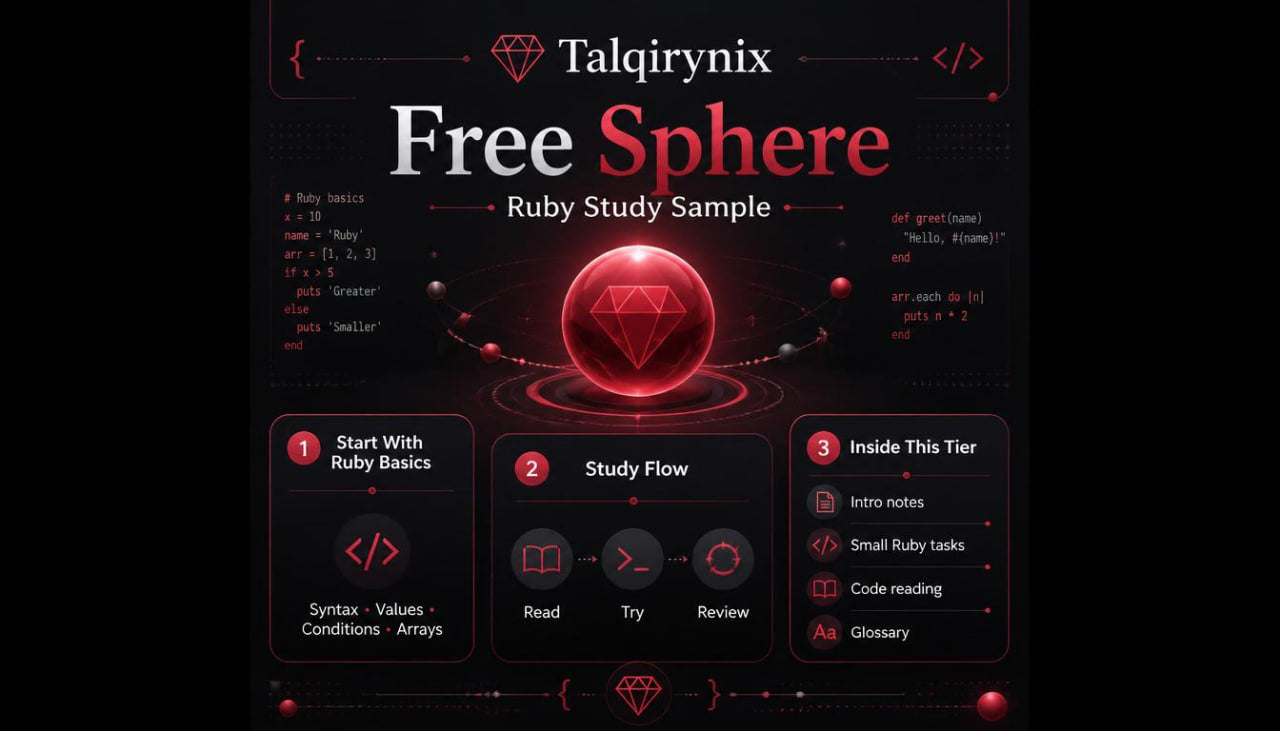
Free Sphere offers a small, organized Ruby study sample from Talqirynix. It helps learners explore core ideas through clear explanations, short examples, and practical exercises. The tier avoids heavy theory at the beginning and focuses on readable code, basic logic, and careful observation. Learners can study how Ruby statements are formed, how values move through code, and how small scripts are built. This tier is intended to help learners decide whether the Talqirynix learning style fits their current study needs.
- What’s Inside
Free Sphere includes an introductory Ruby module with written learning notes, sample code blocks, and small guided tasks. The materials introduce Ruby as a language for writing readable instructions, working with values, and arranging logic into clean steps. Learners review basic syntax, naming patterns, strings, numbers, arrays, and conditional thinking. The tier also includes short exercises where learners read code, adjust small examples, and answer reflection prompts about what each line does. A compact glossary explains common Ruby terms in plain language, so learners can return to it while studying. Free Sphere also includes a short orientation note from Talqirynix that explains how to move through the materials, when to pause, and how to review difficult parts without pressure.
- Who Is This For?
Free Sphere is for learners who are curious about Ruby and want a calm starting point. It is suitable for people who prefer structured materials over scattered notes. It may also fit learners who want to test the tone, pacing, and layout of Talqirynix before choosing another tier. This tier is not built around dramatic outcomes; it is built around careful first contact with Ruby. It works well for learners who value clarity, practice, and a study rhythm that leaves room for review.
- What You’ll Learn
- How Ruby code is written and read in small examples
- How variables store and reuse values
- How strings, numbers, and arrays appear in Ruby tasks
- How conditional logic shapes code behavior
- How to read short Ruby snippets with more attention
- How to complete small practice tasks from written instructions
- How to use a compact glossary while studying
- How Talqirynix organizes Ruby learning materials
- Refund Note
Free Sphere is offered at no cost, so there is no paid checkout to refund for this tier. For paid Talqirynix tiers, the store may include a 30-day refund window written in clear terms on the checkout or policy page. Learners should review the refund details before choosing a paid course tier, because each store policy should be followed as written.
Self-paced learning overview
- 📁 Digital file available after purchase
- 🗂️ Long-term availability
- 🔒 Secure checkout
- 🧩 Content updated in 2026
How do Talqirynix course tiers differ?
How do Talqirynix course tiers differ?
Each tier is arranged with a different study depth, set of materials, and learning scope. Lower tiers introduce Ruby concepts in a lighter format, while higher tiers include broader topic coverage, more guided tasks, and richer practice materials.
Do I need prior coding knowledge?
Do I need prior coding knowledge?
Talqirynix courses are created for learners with different starting points. Some tiers are better for first contact with Ruby, while others are shaped for learners who already know basic syntax and want more structured practice.
What type of materials are included?
What type of materials are included?
Depending on the tier, learners may receive written lessons, guided modules, coding exercises, reference notes, review tasks, and project-style materials. Every tier is organized to support steady study without exaggerated claims or pressure-based wording.
Share