Talqirynix
Luma Deck
Luma Deck
Couldn't load pickup availability
- Problem Statement
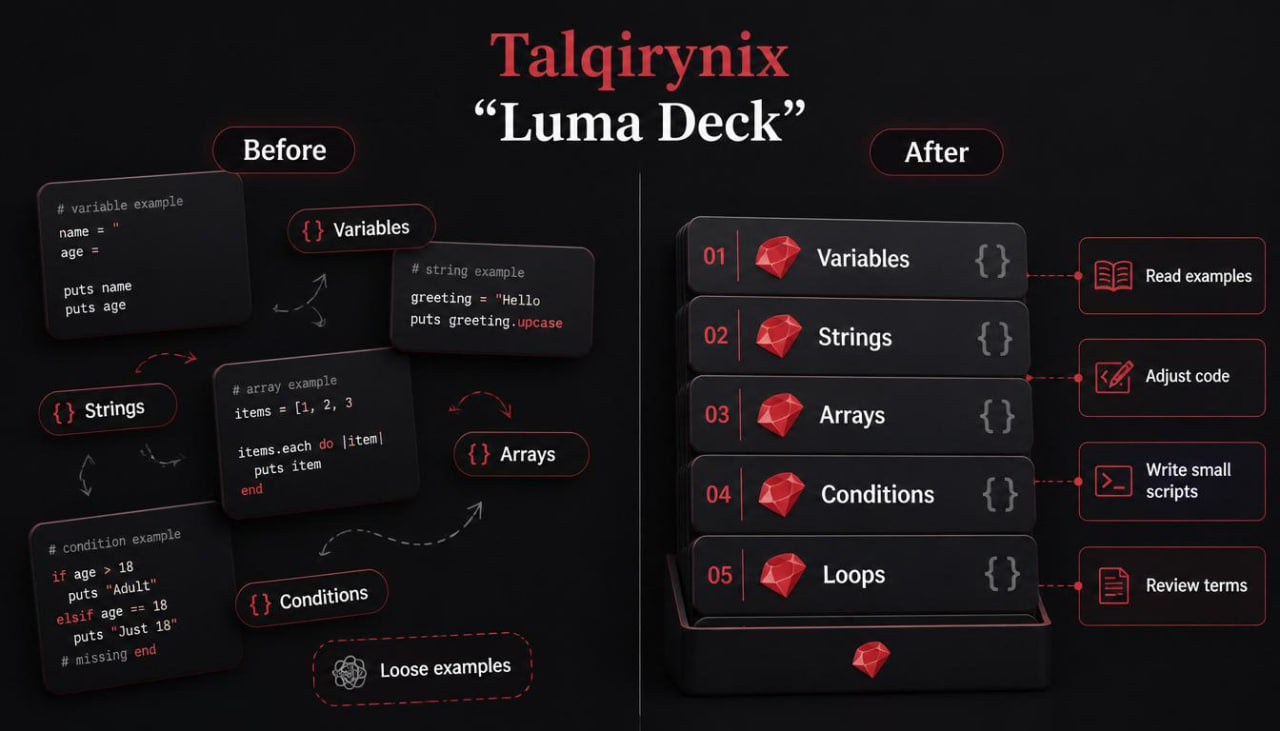
After a first introduction to Ruby, many learners need more than scattered notes or isolated examples. They may understand what a variable is, yet still struggle to combine variables, conditions, arrays, and methods in a clean way. Reading code can feel manageable, but writing even a short script may raise new questions about order, naming, and structure. Without a steady study path, learners may repeat the same topics without seeing how they support one another. Luma Deck responds to that gap with a broader beginner path built around sequence, repetition, and guided practice.
- Solution
Luma Deck gives learners a more developed Ruby study experience while keeping the pace calm and organized. The tier moves from basic syntax into small code patterns, showing how Ruby ideas can be arranged into useful scripts. Each module introduces one topic, explains it in plain language, and then connects it to a short practice task. Learners are guided to read examples carefully, adjust code, and write small pieces on their own. The goal is to help learners build Ruby knowledge through structure, review, and practical work.
- What’s Inside
Luma Deck includes a collection of beginner Ruby modules focused on syntax, values, conditions, arrays, loops, and method basics. The materials are arranged like a study deck, where each section introduces a focused idea and then gives learners room to apply it. Written lessons explain how Ruby code is shaped, why certain patterns are used, and how to notice common mistakes in short examples.
This tier includes guided coding tasks that ask learners to complete missing lines, rewrite small snippets, compare outputs, and describe what a script is doing. It also includes short review cards with key Ruby terms, naming notes, and reminders about punctuation, indentation, and readable structure. Learners receive small practice prompts built around everyday logic, such as sorting values, checking conditions, organizing text, and working with lists.
Luma Deck also includes reflection questions at the end of each module. These questions help learners pause and review how each topic fits into the larger Ruby path. The materials do not rely on loud claims or pressure. They are designed for steady study, careful reading, and repeated practice.
- Who Is This For?
Luma Deck is for learners who already looked at Ruby briefly and want a fuller beginner tier. It fits people who prefer written structure, guided examples, and small tasks that build gradually. It may also suit learners who tried Ruby before but want a cleaner way to revisit the basics. This tier is not built for dramatic claims or rushed outcomes. It is for learners who want a measured route through Ruby fundamentals.
- What You’ll Learn
- How Ruby syntax is arranged in beginner scripts
- How to work with variables, strings, numbers, and arrays
- How conditions guide code behavior
- How loops repeat actions in a controlled way
- How simple methods group reusable logic
- How to read and adjust short Ruby examples
- How to spot common beginner-level code mistakes
- How to organize small Ruby tasks with clearer structure
- Refund Note
Luma Deck may be covered by a 30-day refund window for paid Talqirynix tiers. The refund terms should be written clearly on the store policy page and followed as stated. Learners should review those terms before checkout so they understand how the policy works for this course tier.
Self-paced learning overview
- 📁 Digital file available after purchase
- 🗂️ Long-term availability
- 🔒 Secure checkout
- 🧩 Content updated in 2026
How do Talqirynix course tiers differ?
How do Talqirynix course tiers differ?
Each tier is arranged with a different study depth, set of materials, and learning scope. Lower tiers introduce Ruby concepts in a lighter format, while higher tiers include broader topic coverage, more guided tasks, and richer practice materials.
Do I need prior coding knowledge?
Do I need prior coding knowledge?
Talqirynix courses are created for learners with different starting points. Some tiers are better for first contact with Ruby, while others are shaped for learners who already know basic syntax and want more structured practice.
What type of materials are included?
What type of materials are included?
Depending on the tier, learners may receive written lessons, guided modules, coding exercises, reference notes, review tasks, and project-style materials. Every tier is organized to support steady study without exaggerated claims or pressure-based wording.
Share